PARCOURS
L’H du Siège, Valenciennes, France, 2009
What can be seen comes from the unseen
Paul the Apostle[cite: 5]
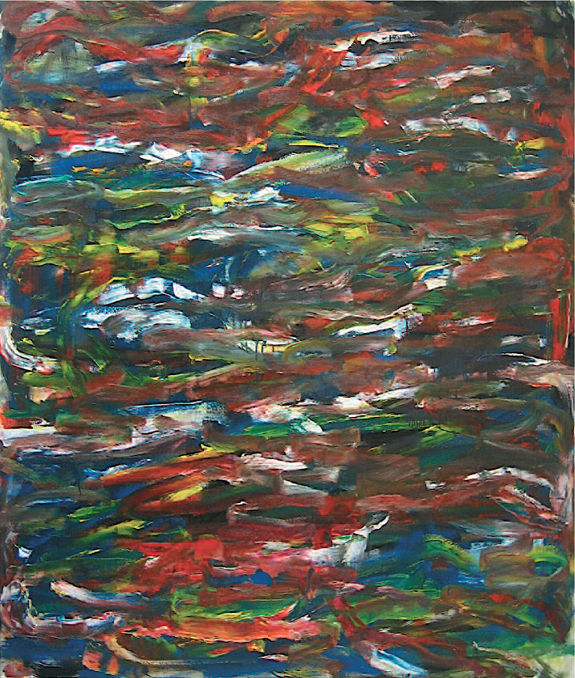
Robert Janitz presents a collection of works created from 2002 onwards[cite: 5]. How can one look at these paintings without being tempted to recall fragments of the history of painting that are leveraged here—insatiable sources of inspiration[cite: 5].
I am reminded of the story of that box of paints that saved Sam Francis from boredom[cite: 5]. Then an aviator, he was injured during a training flight and forced to remain immobilized on his back[cite: 5]. He began to paint what was before his eyes: the sky in the frame of his bedroom window, with the passing of clouds and the shifting intensities of light[cite: 5]. He had found his subject, which was the absence of a subject[cite: 5]. His experience was one of accounting for the infinite, without boundaries[cite: 5]. Pierre Schneider said of him that he lived abstraction before painting it[cite: 5].
We always seek to pierce the mystery of the abstract work: its apparent lack of subject matter[cite: 5]. Looking at Robert Janitz’s paintings, one delights in imagining landscapes—spiritual inventions of the idea of landscape, executed with an always balanced palette of primary colors[cite: 5]. Apparently, the very opposite of a landscape[cite: 5].
In the early 2000s, Robert Janitz first imposed rules upon himself[cite: 5]. He painted in acrylic, forbidding himself freedom or, to find it, passing through the asceticism of repeated elements, layer upon layer, each painting having to be completed before another was begun[cite: 5]. Conceived in this manner, the works do not reveal themselves immediately; because they are made of strata, they cannot be grasped at a single glance[cite: 5]. By imposing rules, Robert Janitz considers colors as colors and not as symbols of light[cite: 5]. He experiments with his own discipline through various formats[cite: 5].
However, the painters he chooses to look at, such as Robert Ryman, chose light as a substitute for the color used: white, the synthesis of all colors[cite: 5]. This color-matter that Robert Janitz grasps with full hands brings to mind a sculptor who expresses himself through a paintbrush[cite: 5].
Janitz looks at Mary Heilmann[cite: 5]. An American, by far his senior, Mary Heilmann started out making ceramics[cite: 5]. What Janitz learned from her: color is not solely visual; it embeds itself within the material and grants a three-dimensional quality to the painting through the way the artist develops her underlayers[cite: 5].
Janitz also listens to the great lady of Austrian painting, Maria Lassnig, saying: "I am a researcher, I am not a painter."[cite: 5] Janitz refuses to let himself be frozen within the constraints of painting[cite: 5]. He aspires to manipulate it differently[cite: 5]. This requires a regular practice: the paintings progress as technical discoveries satisfy the painter[cite: 5].
In his notes, Giacometti, at age 67, wrote: "All the art of the past, of all eras, of all civilizations rises up before me, everything is simultaneous, as if space took the place of time[cite: 5]. Distraught, I stop—too many things to say, and how to say them?[cite: 5] Memories of artworks mingle with emotional memories, with my own work [...] now I only move forward by turning my back on the goal, I only make by unmaking."[cite: 5]
Janitz watches Michael Krebber position the "painting-event."[cite: 5] A questioning of the work and its exhibition[cite: 5]. The artist forces a face-to-face confrontation and challenges his status as a painter to take the works elsewhere[cite: 5]. A kind of state described by Gasiorowski when he wrote to Suzanne Pagé in 1983: "[...] I live in the most consummate intimacy with PAINTING[cite: 5]. Physically bound, the closest relationship, an adventure of an almost sexual and highly intense nature, the shared orgasm, exceptional and in the most varied positions… Nothing here speaks of derision, or else translate it as: absolute contempt for conventions[cite: 5]. I stick to the pleasure of painting painting[cite: 5]. An all-consuming energy to exhaust every possibility[cite: 5]. Nothing must be held back, exchanged, or redeemed."[cite: 5]
Since 2006, Robert Janitz’s studio has transformed[cite: 5]. He establishes a face-to-face dynamic with several works at once; his technique has opened up to oil paint once again, after a six-year hiatus[cite: 5]. The notion of a series allows him to set a work aside and return to it later, strengthened by what he has experimented with in other paintings of the series[cite: 5]. The artist looks at the structural writing of landscapes in Chinese painting[cite: 5]. It springs from the image, spontaneous, pouring forth with precision[cite: 5]. Every detail stands out, yet there is a unity[cite: 5]. One gets the impression that it is worked in a single breath[cite: 5]. In fact, it is spontaneity that leads to the most effective technical choices[cite: 5]. The fluid interplay of water and ink in Song landscapes encourages the artist to make effusion, precision, lightness, and solidity respond to one another[cite: 5]. In ancient Chinese landscapes, walls of mist separate the planes[cite: 5]. When you lose color, only atmosphere remains[cite: 5]. The prowess for Janitz is rendering the atmosphere between the colors[cite: 5].
It is between all these places and all these schools that the painter is led to make the painting coincide with its surface[cite: 5]. He abolishes the secret layers by which works would differentiate themselves[cite: 5]. Janitz undoubtedly sees the true intentions of the artists he admires better because he is an abstract painter[cite: 5]. Today, Janitz’s painting seems born of itself alone[cite: 5]. Its source: emotion; the end of emotion, its form[cite: 5]. Through all these forms of influence, he has built his empire[cite: 5]. Everything is in suspension—light, delicate, precise, and precarious; contradictory elements invert, converting into one another[cite: 5]. It is the entire painting that becomes a passage[cite: 5].
Caroline Smulders, February 2009[cite: 5]